
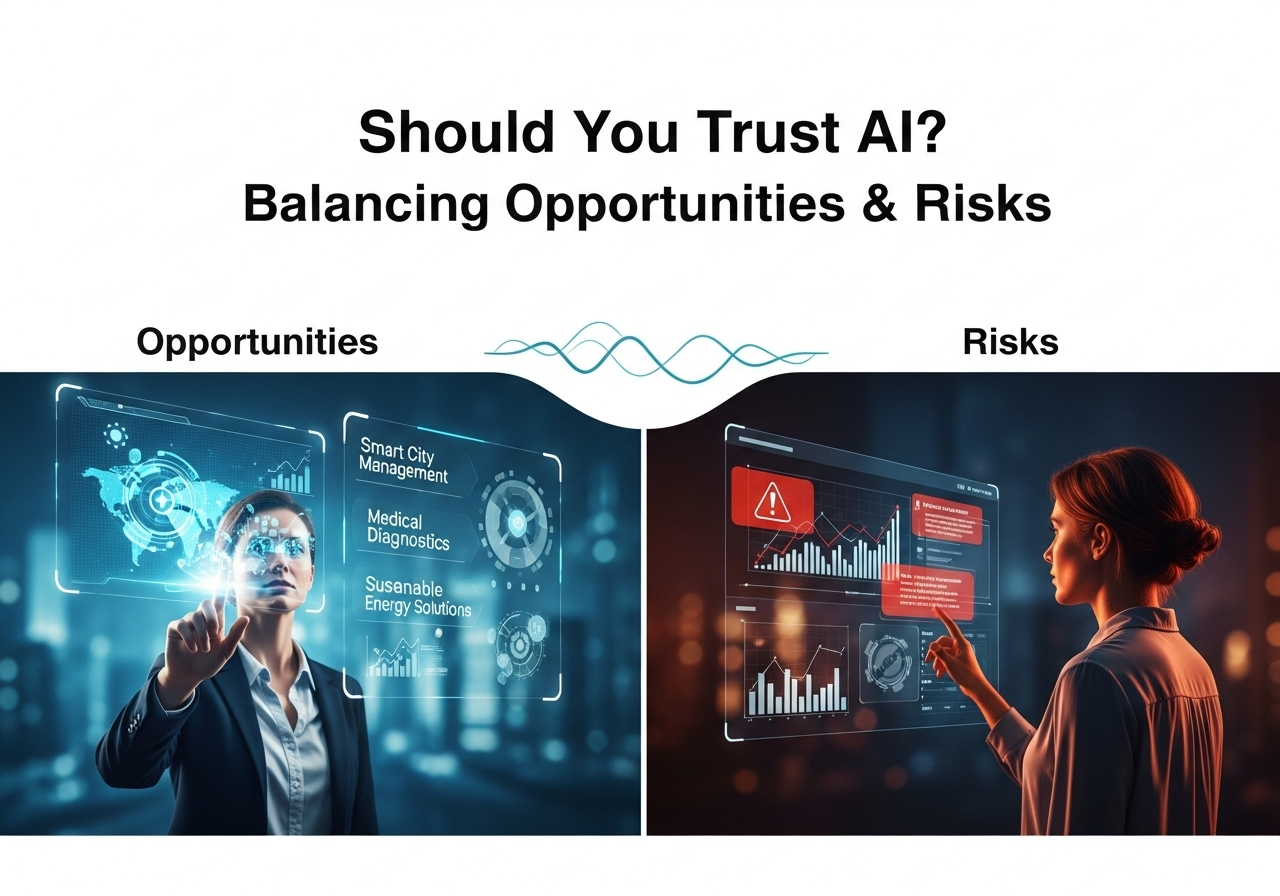

Artificial intelligence (AI) has quickly become one of the most groundbreaking technologies of our age. From powering medical breakthroughs to personalizing your online experience, AI is changing the way we live, work, and relate to one another. But the question on everyone’s mind: should you trust AI? The answer isn’t simple. While AI has gigantic potential for growth, it also poses risks that need monitoring and control. There is a need for a balance of trust and suspicion in order to ensure AI benefits humanity rather than causing harm.
Why AI Triggers Both Trust and Skepticism
AI is already integrated into our day-to-day activities, whether consciously or unconsciously. Search engines, smart assistants, banking services, and even healthcare systems employ algorithms for smooth operations. Such prevalence gives rise to the notion that most people have high expectations for AI’s ability to find solutions to problems faster than a human being.
On the other hand, there are doubts regarding AI due to its “black-box” decision-making in which outputs are created without transparency. Fears of fairness, responsibility, and abuses fuel hesitations. Individuals wonder: if AI is unable to explain its decisions, how will it ensure that it makes the right ones?
Possibilities of AI You Can’t Miss
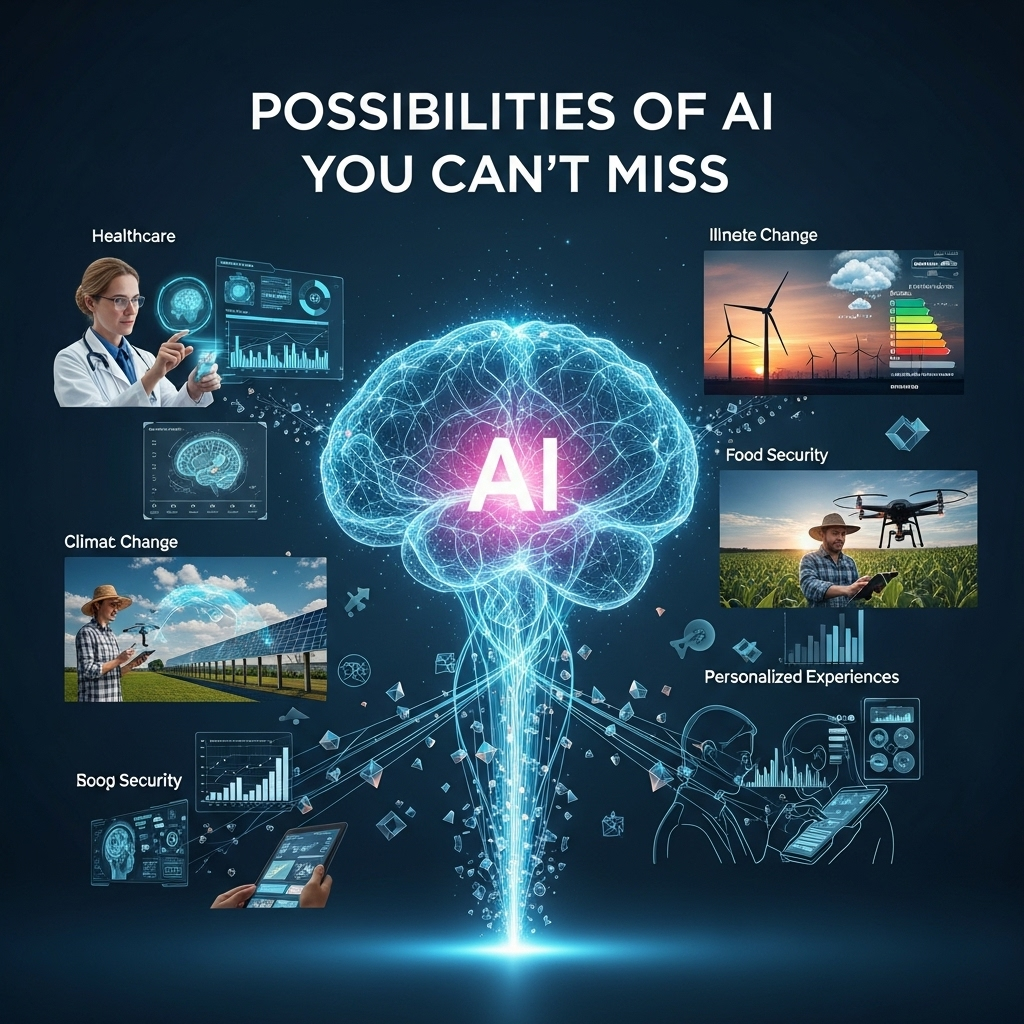
Despite the hesitations, AI has compelling possibilities that can transform industries and society overall.
Challenges Aiding Globally
AI may accelerate solutions to a few of the globe’s most challenging problems:
- Healthcare: Illness prediction, medical image analysis, and personalized treatments.
- Climate Change: Maximizing energy efficiency, climate prediction, and minimizing waste.
- Food Security: Enabling sustainable agriculture with crop prediction and resource allocation.
Economic Growth and Business Innovation
AI drives productivity, lower costs, and new business models. Businesses can automate repetitive work, unlock insights with predictive analytics, and offer faster customer service. Small startups and large corporations alike have witnessed AI as a growth driver.
Personalized Experiences
From adaptive classroom settings in school to recommendation algorithms on video streams, AI makes digital experience personal. Personalization through AI makes it easier for people to learn faster, shop smarter, and discover content that they love.
Catalyst for Innovation
AI is accelerating research and breakthroughs. Scientists use AI to scan massive sets of data when creating drugs, renewable energy, and engineering. Years of research needed yesterday can now be done in months.
Risks of AI That Need to Be Attacked
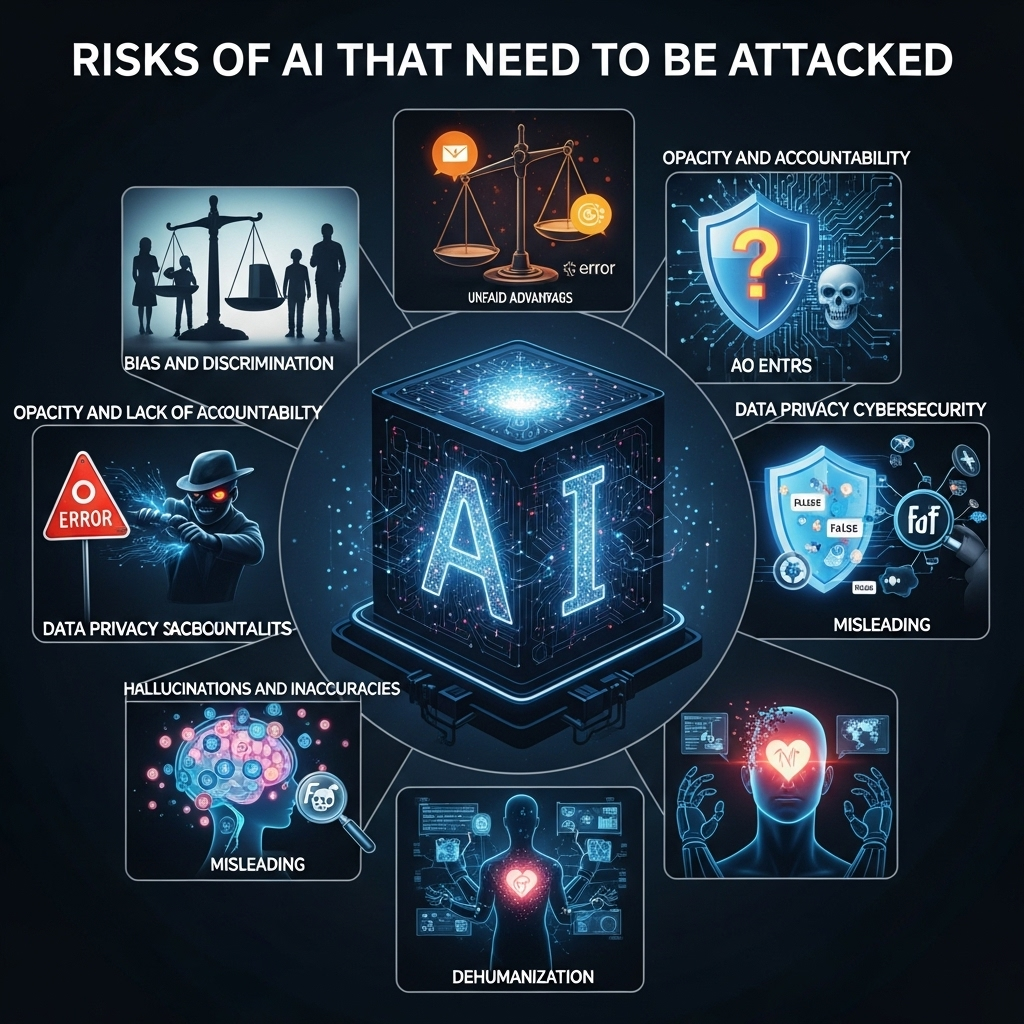
The options come with enormous risks. Blind confidence in AI without regulation can be disastrous.
Bias and Discrimination
AI technology is only as good as the information it’s been trained on. Datasets that mirror societal prejudices can have the effect of making the AI system replicate them, leading to discrimination in hiring choices, creditworthiness, or law enforcement.
Opacity and Lack of Accountability
AI is often a “black box,” with users unaware how and why decisions are being made. Without explicit rules and accountability, it is open for errors or immoral conclusions to go unnoticed.
Data Privacy and Cybersecurity
AI technologies deal with enormous amounts of data, which become the target of cyber attackers. Mismanagement of personal data increases the threats of identity theft, surveillance, and privacy invasions.
Hallucinations and Inaccuracies
Generative AI algorithms occasionally spit out false or deceptive facts. These “hallucinations” can propagate disinformation, especially if consumers rely on AI output without verifying facts.
Dehumanization
While AI works well, it is not empathetic. In areas like education, counseling, or customer support, excessive reliance on AI can strip away the human factor people value.
Can We Really Trust AI? The Core Challenge
The abridged version: AI is reliable as a tool, not an authority. Trust will be context- and purpose-dependent. For example, an AI providing entertainment suggestions is low-risk, but an AI that makes life-or-death decisions in healthcare or finance requires high control levels.
Blind faith in AI is dangerous since technology does not know anything about ethics or morality. Humans must still control the direction of AI systems and make them adhere to society’s values.
How to Build Trust in AI
Building trust in AI is not a matter of eliminating risks altogether, it’s a matter of handling them reasonably. Follow are some primary steps to do that in proportion:
Develop Ethical Frameworks
Clear guidelines must be created for AI development with a focus on fairness, human rights, and safety. Ethical principles can prevent misuse while encouraging innovation.
Ensure Transparency and Explainability
Developers must make AI systems in which the user may observe decisions being made. Explainable AI helps identify errors and gives stakeholders confidence.
Implement Human Oversight
Making human beings “in the loop” ensures AI decisions are reviewed and edited when required. This is especially crucial in medicine, justice, and finance.
Validate AI Outputs
Users need to adopt a doubting mindset and check AI recommendations before applying them. This habit reduces overreliance on potentially erroneous data.
Develop Governance Frameworks
Effective regulation and governance structures are essential. Governments, industries, and international agencies must collaborate to formulate standards, audits, and accountability protocols.
The Future of Reliable AI
In the future, AI is likely to be shaped by increased regulation and monitoring. Governments are already developing policies for ensuring ethical use, while companies are creating “AI ethics boards” to guide development. Independent audits and transparency reports will likely become standard practice in the industry.
The future of AI trust depends on collaboration across industries. By using human control, ethical design, and governance, AI can continue to spur innovation with less damage.
FAQs: Should You Trust AI?
Q: What are the biggest risks of AI today?
The largest risks are decision-making bias, lack of transparency, privacy violations, cybersecurity threats, and errors in AI outputs.
Q: How can businesses use AI responsibly?
Businesses can use ethical guidelines, be transparent, include human monitoring, and regularly audit AI systems to prevent negative effects.
Q: Can AI ever be 100% trustworthy?
No, AI cannot absolutely be trusted because it lacks moral thinking. Nevertheless, with proper controls and monitoring, its trustworthiness can be significantly increased.
Q: How does transparency aid in building trust in AI?
Transparency simplifies it to observe what’s occurring, why, and how AI is deciding, and it is easier to spot errors, correct prejudice, and hold systems accountable.
Q: What is the human role in supervising AI?
Humans are essential in auditing AI outputs, setting ethical boundaries, and making final decisions in sensitive areas like healthcare, finance, and education.
Conclusion
Thus, should you trust AI? The answer is balance. AI has the capability to revolutionize healthcare, business, and global problem-solving. But without proper management, dangers like bias, privacy intrusions, and lack of accountability run the risk of undermining progress.
AI has to complement human judgment, not displace it. The destiny of the technology will not only rest with algorithms but also with ethical choices that human beings make today. People can trust AI, but only if the technology is transparent, if it is accountable, and if human beings are made accountable.