

Artificial Intelligence has become part of daily business operations. Companies use automation to make customer service efficient, while improving their forecasting and control over vital decisions across different industries. The rapid growth of AI created a strong need for clear rules that protect users while supporting innovation. Governments around the globe are responding with new laws that shape how companies use AI systems in 2025 and 2026.
Businesses can no longer afford to look at AI compliance as optional. Companies of all sizes need to understand this increasingly shifting legal landscape if they are to remain competitive and trusted. Though the new set of rules brings responsibility, there is also a corresponding opportunity for companies that move promptly. This guide will explain how global AI regulations work, how they affect businesses, and how companies can prepare for the future with practical steps.
The Global Push for AI Regulation
Countries are introducing new frameworks to make certain that AI systems operate safely. Each region follows its own model, but the purpose is the same: to protect users and to set expectations for industry players. This sets up a complex environment for companies operating in multiple markets.
The European Union enacted the EU AI Act, placing this as the most comprehensive AI regulation in the world to date. Unacceptable uses under the draft include systems like predictive policing or public space facial recognition. These are banned, outright. High-risk systems include things like medical AI, biometric identification, and financial scoring. Such tools will need to be extensively tested, documented, and certified. The structure creates a predictable compliance process, but businesses need dedicated teams to meet the requirements.
The United States takes a sector-specific approach. Federal agencies promulgate rules for their respective industries: the FDA regulates AI in health, the SEC regulates AI in financial markets, and the Department of Defense sets expectations for military AI. There is no one overarching national law for AI. This offers businesses flexibility but, simultaneously, creates inconsistency across sectors. Businesses must track various agencies simultaneously to remain compliant.
The Asia-Pacific region focuses on balanced and innovation-friendly frameworks. Singapore’s Model AI Governance Framework facilitates explainability and non-discrimination without hindering development. Japan and South Korea have similar approaches that support responsible innovation. Malaysia is working towards alignment with ASEAN initiatives and the National AI Roadmap in support of adoption and governance. This model is balanced and assists startups looking for regulatory clarity with no heavy restrictions.
China has imposed strict controls on generative AI, recommendation algorithms, and deepfake content. Firms have to register with authorities about AI services and make sure outputs meet national requirements. A structured compliance process accompanies the need to operate in China, which leads to implications for firms desirous of entry or expansion in the market.
Key Areas Covered by AI Regulations
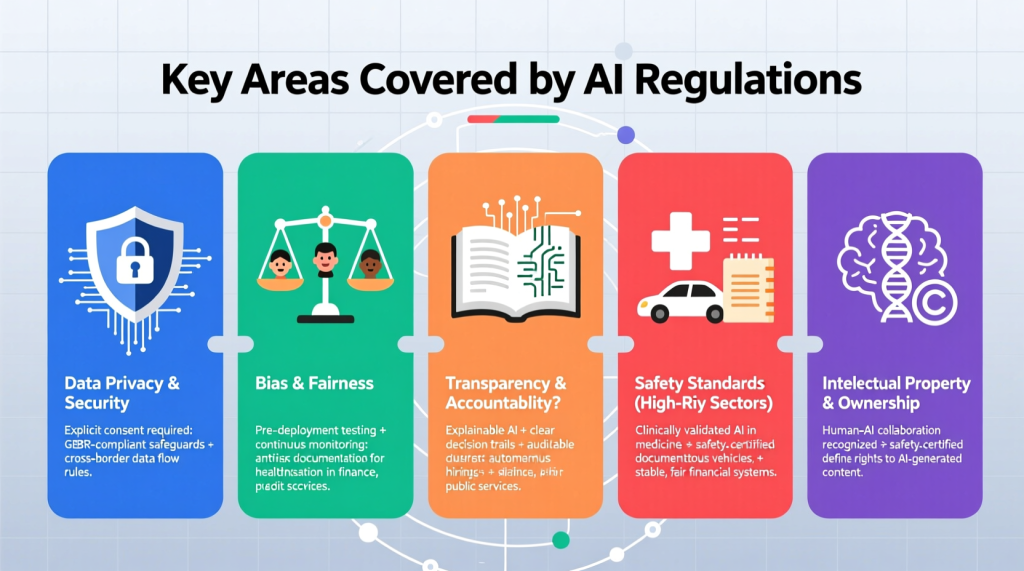
Most AI-related legislation directly focuses on several core areas that drive business process operations. These areas shape the development, testing, deployment, and monitoring of AI systems.
Data Privacy and Security
AI needs a tremendous amount of data. This is regulated by laws that require companies to get explicit consent for collecting any personal information. Businesses must implement stringent measures to safeguard data and adhere to requirements for international data flow. These statutes, such as the EU GDPR, have been at the core of privacy regulation, and similar criteria continue to emerge in AI-specific rules. Companies failing to adequately shield data risk legal and reputational consequences.
Bias and Fairness in Algorithms
Regulators are expecting companies to test AI systems for discrimination against users. Testing of algorithms before deployment is required, supplemented by ongoing monitoring. Recruitment tools should not be excluding groups unduly. Credit-scoring systems should provide fair outcomes. All these demands bring out the direct need for structured detection and documentation of bias.
Transparency and Accountability
Users and regulators are expecting clarity as to how AI decisions are reached. Companies will be under an obligation to provide clear explanations that are easily understood, particularly for the healthcare, finance, and public service sectors. Detailed documentation of data sources, training methods, testing procedures, and updates will have to be kept by businesses, as authorities can request records from them anytime.
Safety Standards for High Risk Sectors
AI in health, transport, finance, and defense is governed by high standards. Medical use AI tools have to be clinically validated with the highest intensity. For instance, self-driving cars must pass safety standards before being commercialized. Financial systems are expected to provide stability and fairness. These standards aim to protect the public while minimizing industry-wide risks.
Intellectual Property and Ownership
AI can create content, designs, and inventions. Countries are defining how ownership works when the creative process is assisted by AI. Some jurisdictions recognize AI-assisted works, where both human and AI contributions are recognized. Companies need to review contracts to protect rights and ownership of AI-generated content.
Impact of AI Regulations on Businesses
The new legal landscape creates both challenges and advantages. Companies that understand these changes early can build stronger competitive positions.
Compliance requires investment. Companies need audit tools, documentation systems, bias detection methods, and explainable AI technologies. Large corporations can handle this more easily than smaller firms, which may require outside assistance.
Some applications of AI have restrictions. Tools for surveillance or public space tracking may be banned in some markets. Firms have to adapt their strategy to avoid various legal risks.
Ethical AI becomes a competitive advantage. Strong governance and responsibility appeal more to consumers and investors. A clear compliance sends a message of trust.
Users feel safe, and so brand loyalty increases. Companies can build long-term relationships with customers through data protection and transparency in AI systems.
AI Regulations in Malaysia and Southeast Asia
Malaysia is fast becoming an important player in regional AI governance. The National AI Roadmap clearly lays out targets with respect to adoption in key sectors like health, education, manufacturing, and public services. It also outlines the need for responsible development.
The Personal Data Protection Act supports strong data governance. It sets forth clear expectations for companies using personal data within AI systems. This provides a sound basis for compliance with respect to AI.
Malaysia is active in ASEAN cooperation, where shared principles on ethics and governance also support cross-border operations and regional integration. This benefits businesses looking for predictable rules across a number of Southeast Asian markets.
Malaysia’s regulatory direction is supportive of startup growth. Early adopters of compliance practices attract investors who would expect responsible use of AI.
Benefits of AI Regulations to Businesses
The long-term effect of AI regulation is positive to entities that prioritize responsible practices, as it gives them a playing field with rule-bound competitors, reduces risks, and lays a foundation for market confidence.
Standard rules prevent companies from using unsafe AI to gain an unfair advantage. Compliance systems reduce potential legal problems. Clear frameworks help businesses build trust with customers and investors. This makes it easier for companies that meet global standards to enter new international markets.
Challenges to be Overcome by Businesses
Companies need to deal with a number of challenges in evolving AI legislation. Compliance involves cost, procedures, and availability of skilled professionals. Legal terms are often not clearly defined, which creates uncertainty. Global companies have to operate under various rules across different regions. Talent shortages in AI governance and compliance make it more challenging to build strong internal teams.
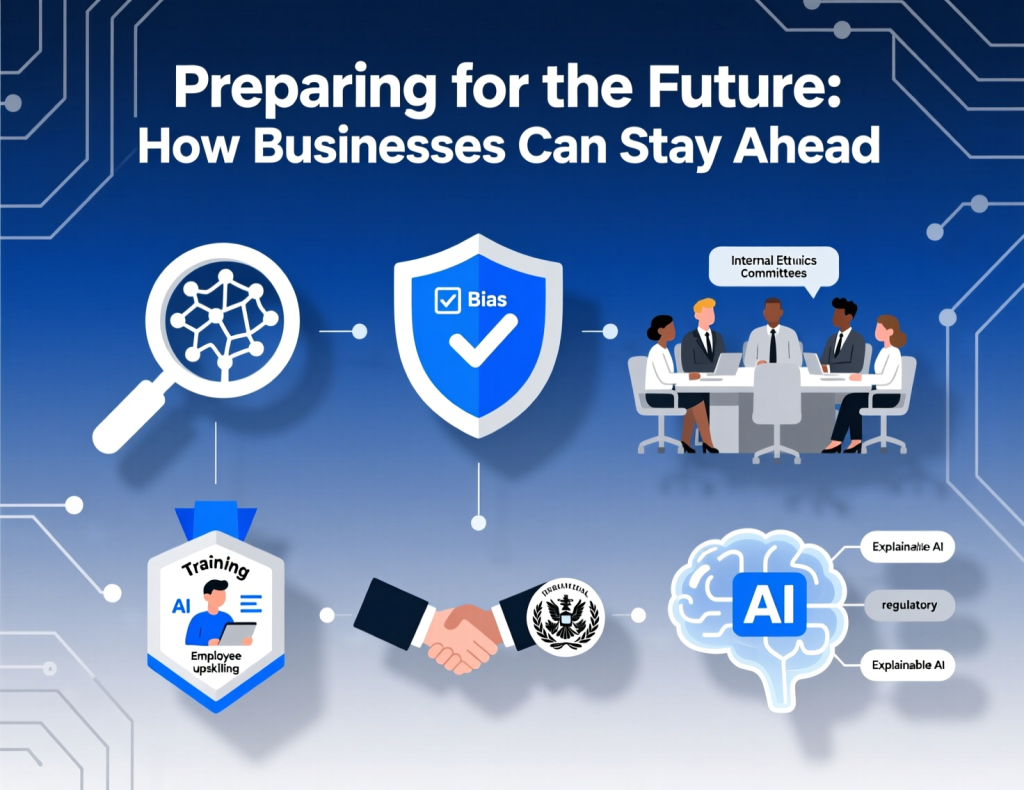
Preparing for the Future: How Businesses Can Stay Ahead
Companies that prepare early can reduce risks and build stronger AI capabilities. Regular audits help detect bias, security gaps, and compliance issues. Internal ethics committees guide responsible development. Training employees ensures that teams understand concepts of fairness, accountability, and data protection. Engagement with regulators keeps businesses informed. Explainable AI systems increase trust and reduce legal risk.
FAQ: AI Regulations and Business Compliance
What is the EU AI Act, and why does it matter?
It is the first complete AI law in the world; it really sets an example, which other countries also follow. Companies operating in Europe have to adhere to the rules.
Do AI laws apply to small companies?
Yes, requirements might scale with company size, but every business has rules on privacy, fairness, and transparency.
How can businesses reduce AI compliance costs?
The companies can focus on the key areas first, such as data protection and bias testing. Outsourcing some compliance tasks helps reduce internal costs.
Which industries face the toughest regulations?
Healthcare, transport, finance, defense, and education are under strict oversight because their decisions affect safety and well-being.
How is Malaysia getting ready for AI regulation?
Malaysia is building a balanced and responsible AI ecosystem through its National AI Roadmap, enforcement of the PDPA, and cooperation within ASEAN.
Conclusion: Building Trust Through Responsible AI
AI regulation is becoming integral to the digital economy. New laws will pave the way for corporate systems that are safer, clearer, and more responsible. Those that act early will earn trust and long-term value. AI is at a stage where innovation and governance go hand in hand. Those preparing now will also lead the next chapter of growth in Malaysia and the global market.